Weighted risk score from activity staleness, close date validity, and contact engagement. Configurable weights and AI threshold.
A local control plane for AI
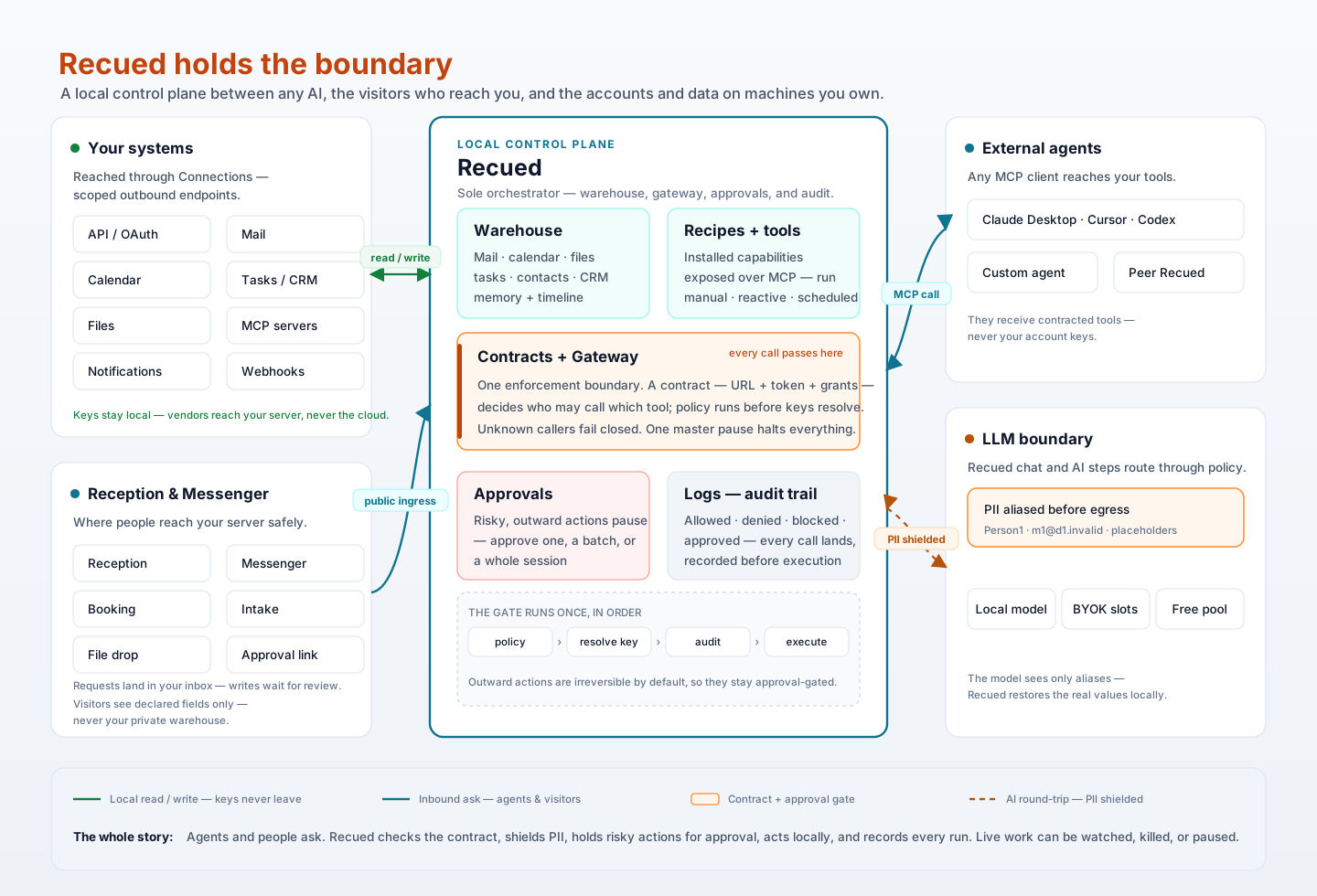
Recued holds the space between you and AI.
The local control plane between you and any AI — it reads and acts across your world on a server you own, with every action granted in advance, gated at one boundary, audited, and reversible. Your data and your keys never touch anyone's cloud.
Local-first
Permission-gated
Free & open
Bring your own keys
Search the marketplace
Find installable recipes, packs, publishers, platforms, and tags.
Featured recipes
View all 138 recipesA second recipe aiming at a tag another publisher already owns.
Drive fixture proving a board is created by its first submission.
Featured packs
View all 927 packsV3 QuickBooks Online capability pack for the SMB-finance wedge. Declares canonical accounting operations over QuickBooks invoices, bills, expenses (Purchase), customer payments, refunds, customers, vendors, chart of accounts (Account), daily bookkeeping views, and financial reports. Reads flow after connection grant; invoice/bill/expense/customer/vendor writes ask + diff; customer-payment, refund, and invoice-void are destructive/always-ask so money movement never rides a session grant. Mirrors the shipped Stripe billing-pack entity_platform pattern. The READ surface is LIVE-VERIFIED against the QuickBooks Online sandbox (2026-06-13): OAuth token exchange, the /query endpoint (base https://quickbooks.api.intuit.com, /v3/company/<realmId>/query?query=<SQL>&minorversion=75 -> QueryResponse.<Entity>[]), single read-by-id (/<entity>/<id> -> {<Entity>}), realmId-in-path + sandbox base, and every read field_path all confirmed against live sandbox data. WRITE ops (create/update/void/payment/refund) are authored to the same documented v3 shapes but were NOT exercised live (non-mutating verification only). This is the QuickBooks catalog + money-write surface ONLY — the two vendor-agnostic accounting workflows (overdue-invoice-chase, accounting-daily-back-office) ship in the vendor-neutral `acct` pack (install it alongside this one for the workflows); their canonical `core.acct.*` read op-steps resolve against THIS vendor's catalog at run (dispatch-time), projecting QuickBooks' raw records to the canonical accounting fields. Canonical accounting op-steps are read-only; money writes ride the gated ingredient binding. See docs/unified-pack-exploration/smb-finance-wedge.spec.md.
V3 deterministic XML validation and formatting capability pack. By-value connector composition (service_kind=cli, no separate ingredient): one local xmllint CLI ingredient exposes readiness, well-formedness validation, captured XML formatting, and ordered two-file XSD/RelaxNG validation operations. Fixed-function and reproducible: file inputs are materialized by the executor, formatted output is written only to an engine-managed output directory, schema validation returns only exit status, and recipes cannot pass arbitrary parser flags, DTD URLs, network fetches, shell wrappers, or caller-controlled output paths. Requires xmllint on PATH (Debian/Ubuntu: apt install libxml2-utils; macOS: xmllint ships with libxml2/system tools). Local and no-egress.
V3 deterministic YAML lint capability pack. By-value connector composition (service_kind=cli, no separate ingredient): the local yamllint CLI checks one trusted local YAML file or directory and returns parsable text diagnostics via the yaml.lint catalog operation. Fixed-function and reproducible: no arbitrary yamllint flags, no caller-supplied config path, no stdin stream, no strict-mode toggle, no shell wrapper, and no network egress. The built-in relaxed profile is pinned through argv so ambient .yamllint files, user config files, and YAMLLINT_CONFIG_FILE do not change pack behavior. Lint findings are represented as text output instead of failing the op; real invocation errors still fail. Requires yamllint on PATH. Local and no-egress.
Publishers
Publish your recipeMarketplace content is free.
Publishing requires signup because the account owns your namespace. Pro is a convenience bundle for reserved handles, DDNS, and ACME setup; it is not a marketplace content gate.